
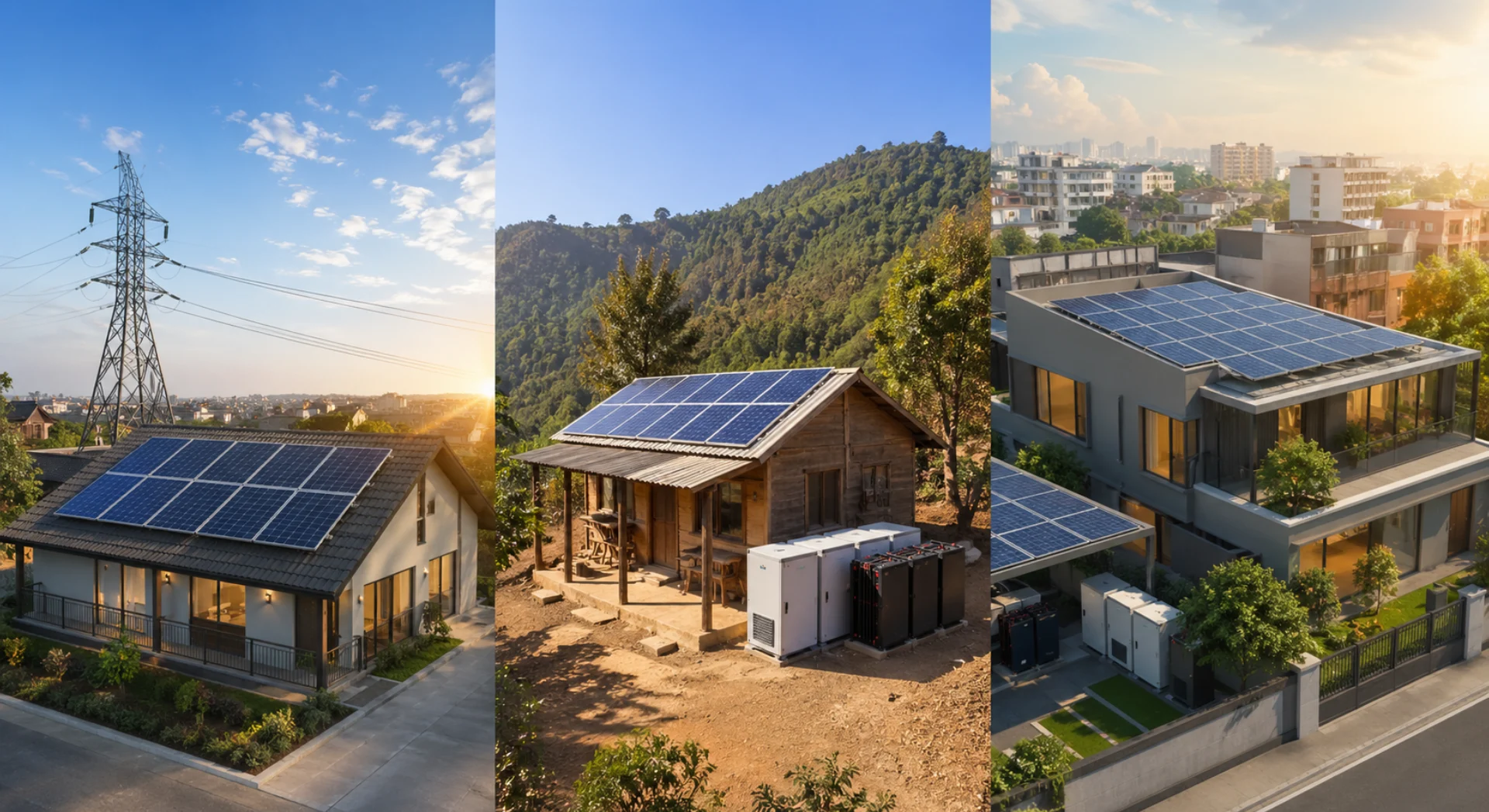
Still Paying Sky-High Electricity Bills?
Solar is no longer the future — it’s the smartest financial decision you can make today. But with three types of solar systems available, which one is right for your home?
40%
Rise in electricity tariffs (5 yrs)
70%
Drop in solar panel prices (decade)
₹78K
Goverment subsidy available
25%
Solar performance warranty
Every solar system works the same way at its core — panels capture sunlight and convert it into electricity. The difference lies in what happens next. Understanding that one idea will make your solar decision crystal clear.
The Core Difference — In One Line
On-Grid: Solar + Grid (cheapest, fastest returns, no backup during outages)
Off-Grid: Solar + Battery (full independence, ideal for remote/rural areas)
Hybrid: Solar + Battery + Grid (best of both worlds, smart urban choice)
01 On-Grid Solar — Low Cost, Maximum Returns
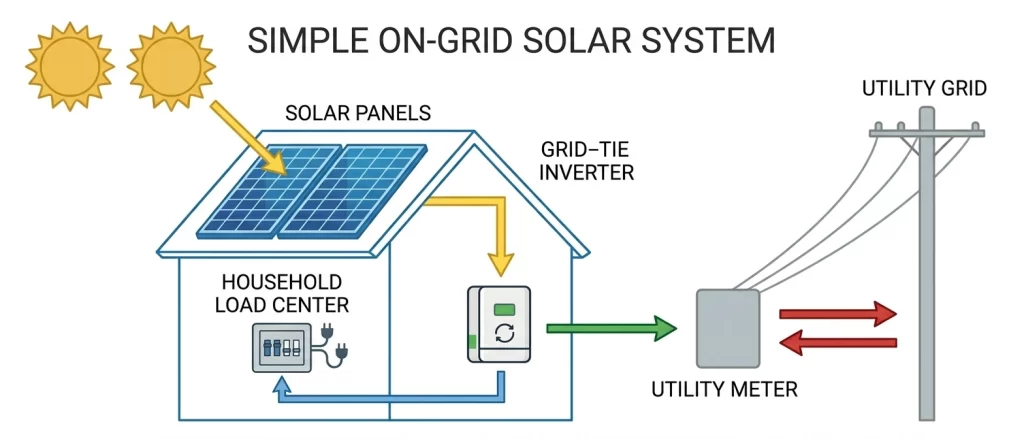
On-Grid Solar system
Grid-tied | Lower Cost |Best ROI | Ideal for Cities
An on-grid system connects your solar panels directly to the public electricity grid. During the day your panels power your home — any surplus energy is exported to the grid and credited on your bill via Net Metering. At night the grid acts as your free storage. No batteries. No complexity. Maximum ROI.
Why it works so well for Indian cities
✓ Lowest installation cost — no expensive battery required
✓ Payback in just 3–5 years — panels last 25+ years after
✓ Net metering earns ₹3–7 per exported unit
✓ Eligible for PM Surya Ghar subsidy up to ₹78,000
✓ Minimal maintenance — virtually set-and-forget
Where it falls short
✗ Powers off during grid outages — shuts down for safety
✗ Requires DISCOM approval and net metering paperwork
✗ Not suitable for areas with frequent long power cuts
♦ Best For — On-Grid
Urban & semi-urban homes with stable power supply (< 1 hr/day outage)
Apartments, offices, and commercial buildings in metro cities
Anyone who wants the fastest return on investment
02 Off-Grid Solar — Own Your Energy Completely
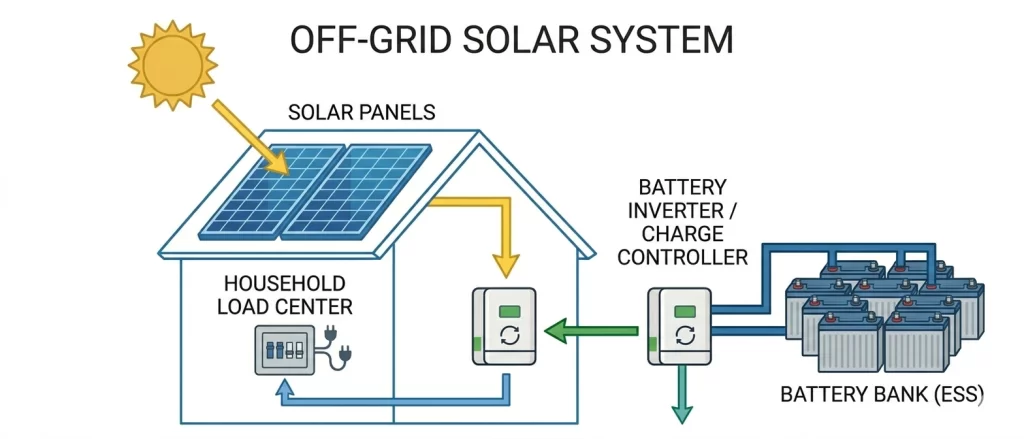
Off-Grid Solar System
Battery-powered | Full independence | Best for remote areas
An off-grid system severs your connection to the utility grid entirely. Solar panels charge a battery bank during the day; at night your home draws from those batteries. No electricity bills. No DISCOM dependency. No power cuts. You are your own power plant.
The freedom it gives you
✓ Total energy independence — zero electricity bills forever
✓ Works where the grid doesn’t reach — farms, remote land, villages
✓ Completely immune to tariff hikes and grid failures
✓ No regulatory approvals or net metering paperwork
The trade-offs to weight
✗ Highest upfront investment — batteries add significant cost
✗ Lead-acid batteries need replacing every 3–5 years
✗ Requires careful energy management on consecutive cloudy days
✗ No way to monetise surplus generation
♦ Best For — Off-Grid
Farms, agricultural land, and rural properties without reliable grid
Remote resorts, telecom towers, and off-grid industrial sites
Areas with 6+ hours of daily power cuts — where on-grid is impractical
03 Hybrid Solar — The Smart Urban Choice
Off-Grid Solar System
Battery-powered | Full independence | Best for remote areas
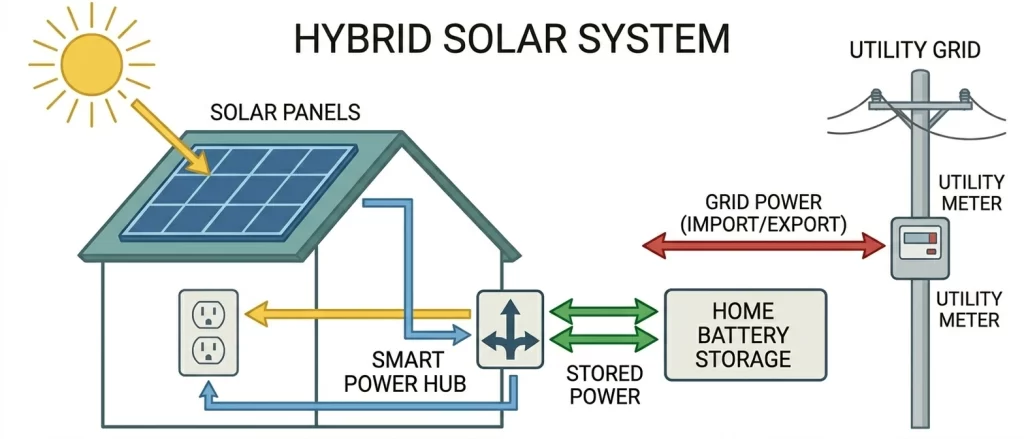
A hybrid system gives you everything. Grid connection for net metering credits. Battery storage for outage protection. During the day solar powers your home and charges your batteries. At night — or during a power cut — your batteries kick in automatically. You never feel an interruption. You never pay for power you generate yourself.
What makes it the gold standard
✓ Uninterrupted power — outages become completely invisible
✓ Maximises self-consumption — uses solar first, grid only as backup
✓ Time-of-Day (ToD) tariff savings — avoid peak-hour grid rates
✓ Still earns net metering credits for surplus export
✓ Future-proof — as battery costs fall, ROI keeps improving
What to keep in mind
✗ Higher upfront investment than on-grid systems
✗ Longer payback period of 5–8 years
✗ Battery needs monitoring and eventual replacement
♦ Best For — Hybrid
Tier-1 and Tier-2 cities with 2–6 hours of daily power cuts
Businesses, clinics, and households where uninterrupted power is critical
EV owners who want to charge their vehicle from clean self-generated solar
Ready to Switch to Solar? Get Your FREE Consultation Today!
1000+ Buildings Powered | Govt. Certified & Trusted | Expert Installation
Visit – https://www.solarsmiths.com/
Side-by-Side — The Complete Comparison
One table to rule them all. Compare every factor that matters before you decide:
| Factor | On-Grid | Off-Grid | Hybrid |
|---|---|---|---|
| Grid Connection | ✓ Yes | ✗ No | ✓ Yes |
| Battery Storage | ✗ No | ✓ Yes | ✓ Yes |
| Works During Outages | ✗ No | ✓ Yes | ✓ Yes |
| Works at Night | Via Grid | Via Battery | Battery + Grid |
| Net Metering / Credits | ✓ Yes | ✗ No | ✓ Yes |
| Govt Subsidy | Up to ₹78K | Limited | Up to ₹78K |
| Energy Independence | Partial | Full | High |
| Approx. Cost (3kW) | ₹1.5–2 Lakh | ₹2.5–4 Lakh | ₹2.8–4.5 Lakh |
| Payback Period | 3–5 Years | 6–10 Years | 5–8 Years |
| Maintenance Level | Low | Medium | Medium |
| Ideal Location | Cities | Rural/Remote | Frequent Outages |
| Best System Size | 1–10 kW | 1–5 kW | 3–15 kW |
Get your personalised cost estimate: www.solarsmiths.com
♦ GOVT SCHEME – PM Ghar Muft Bijli Yojana
Central Subsidy up to ₹78.,000 on rooftop solar – directly to your bank account
300 free unit of electricity per month for eligible households
– Register at pmsuryaghar.gov.in or through solarsmiths consultant
Which System Is Right for YOU?
Stop guessing. Use this decision matrix — the most practical tool you’ll find for choosing between the three systems in an Indian context:
| Your Situation | On-Grid | Off-Grid | Hybrid |
|---|---|---|---|
| Stable grid (< 1 hr/day cuts) | Best Fit | Not Ideal | Consider |
| Moderate cuts (2–6 hrs/day) | Consider | Consider | Best Fit |
| Severe cuts (6+ hrs/day) | Not Ideal | Best Fit | Best Fit |
| No grid access (remote area) | Not Ideal | Best Fit | Not Ideal |
| Limited / tight budget | Best Fit | Not Ideal | Consider |
| Want zero electricity bills | Consider | Best Fit | Best Fit |
| Want fastest ROI | Best Fit | Not Ideal | Consider |
| Have an EV / high energy needs | Consider | Consider | Best Fit |
| Commercial / industrial property | Best Fit | Consider | Best Fit |
| Rural or agricultural land | Consider | Best Fit | Consider |
| Maximum energy security | Not Ideal | Best Fit | Best Fit |
Before You Install — 5 Things to Verify
♦ Did You Know – Solar in India
India is among the fastest-growing 2025 the best time to invest solar markets globally, adding massive capacity every year.
Solar panel prices have dropped by nearly 90% over the past decade — making now one of the best times to invest in solar energy.
Your solar system is only as good as its design. Verify these five factors before signing any contract:
① Rooftop area & orientation — South-facing roofs maximise yield. You need ~10 sq.ft. per 100W of capacity.
② Shading analysis — Even 20% shade can cut output by 50%. Insist on a shadow study before sizing.
③ Sanctioned load — Your DISCOM contract determines maximum system size for net metering eligibility.
④ Battery chemistry — LiFePO4 lithium lasts 10–15 years; lead-acid 3–5. The premium pays for itself.
⑤ MNRE-certified installer — Only empanelled installers qualify for PM Surya Ghar subsidies. Always verify.
Conclusion: Your Solar Decision Starts Today
The sun doesn’t send you a bill. The grid does.
Whether you choose an on-grid system for the fastest returns, an off-grid setup for complete independence, or a hybrid system for the best of both worlds — one thing is certain: going solar is the smartest financial and environmental decision you can make as an Indian homeowner.
The technology is mature. The prices are at an all-time low. The government is actively subsidising your switch with up to ₹78,000 in direct benefits. And solar panels installed today will still be powering your home in 2050 — long after they’ve paid for themselves many times over.
Don’t let the complexity of choosing a system hold you back. The answer is simpler than you think:
- Stable power in your city? → Go On-Grid. Start saving from month one.
- Frequent power cuts? → Go Hybrid. Never lose power again.
- Remote location or no grid access? → Go Off-Grid. Own your energy completely.
FAQ's
Yes — if a hybrid-ready inverter was installed from the start, adding batteries later is straightforward. Always ask your installer for a future-proof inverter during the initial installation.
Net metering is available in all states following the Electricity (Rights of Consumers) Rules 2020. Rates vary by DISCOM. SolarSmiths handles the entire application and approval process for you.
Quality Tier-1 panels carry a 25-year performance warranty — generating at least 80% of rated output through year 25. Inverters typically last 10–15 years. A system installed today will still power your home in 2050.
Launched in February 2024, this central government scheme provides subsidies up to ₹78,000 for rooftop solar and 300 free units of electricity per month for eligible homes. Register at pmsuryaghar.gov.in or through your SolarSmiths consultant.
Accordion Content


