India is a country where Solar power is a fast-developing industry. The installed solar capacity has reached 32.527 GW as of 30 November 2019. India’s success stories are proven through its compelling business case of maximizing the falling renewable technology costs as the key towards future energy decarburization.
The most crucial benefit of solar energy is a truly renewable source of energy. There are no hazardous greenhouse gas emissions which are released in the atmosphere when you use Solar Power System to create electricity.
WHAT IS SOLAR POWER SYSTEM?
These are the solar panels that convert energy received from a natural resource such as Sun into electricity. The technology involved in this process is about collecting the photovoltaic cells, which then generate electricity through the photovoltaic effect, which is utilized for your home, industrial and commercial purposes.
The Solar Power System is a collection of solar cells where the maximum amount of light hits the cell the more electricity generated
HOW DOES IT WORK?
Environmental consciousness acts as a natural nuclear reactor which releases tiny packets of energy called photons travelling through 93 million miles from the Sun to Earth in about 8.5 minutes. Every hour, a lot of photons impacts planet to generate enough solar energy to satisfy global energy needs for an entire year theoretically.
There are photons which hits the solar cells, to knock electrons free from atom hence generating a flow of electricity. Various cells together make up a solar panel, while multiple panels wired together will result in a solar array. Most of the solar panel made up using crystalline silicon solar cells.
TYPES OF SOLAR POWER SYSTEM
1.On Grid Solar Power System
These are the type of system which is having high usage in home, commercial and industrial purpose. Here the solar Power systems that only generate power when the utility power grid is available. They must connect to the network to function and can send excess of power generated back to the network when you are overproducing hence crediting for further usage.

There are three On grid system components, such as
- Panels
- Inverters
- Installation Kit
Advantage
- Generates power for residential, commercial and industrial usage and excess electricity is sell to the government
- Free of cost electricity for the next 25 years and five years payback time
- Saves ample of electricity
Disadvantage
- No backup and system does not work when there is no electricity and supply from discom.
2. Off-Grid Solar Power System
An off-grid system does not connect to the electricity grid and hence requires battery storage. An off-grid solar system is a design which will generate enough power throughout the year and have enough battery capacity to meet the residential, industrial and commercial requirements, even in the depths of winter when there is dim sunlight.
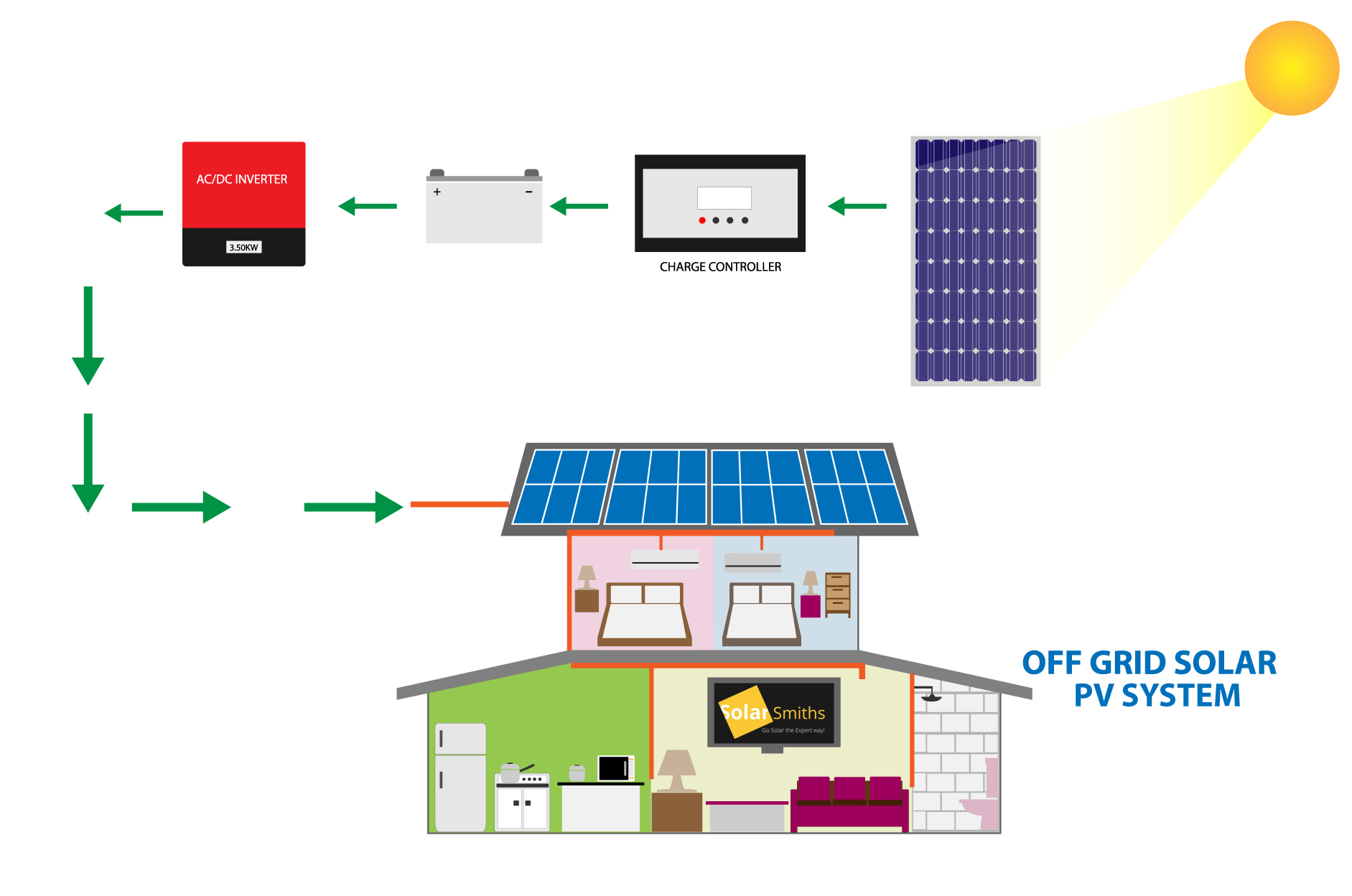
It is a type of solar power system with a backup which works in day and night both, during the day, the solar panel charges the battery. At night Inverter runs your appliances, machineries, gadgets, agricultural and industrial devices using the battery power when the sun is not available.
Advantage
- No dependency on the government for electricity
Disadvantages
- Batteries are required to deliver electricity consistently throughout the day and night hence leading to high maintenance costs due to batteries
- Surplus energy production could go to waste.
- Batteries are highly expensive
3. Hybrid Solar Power System
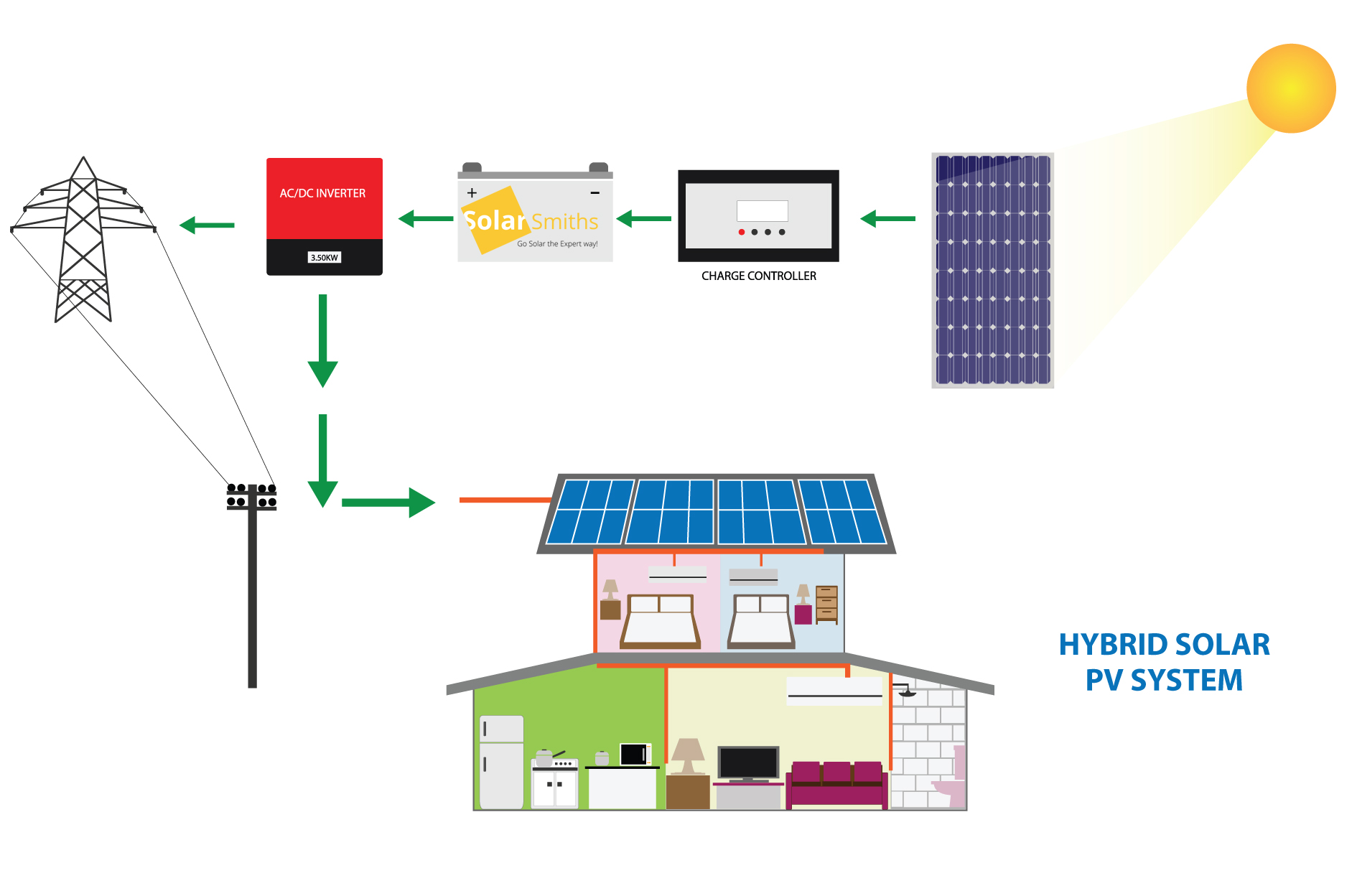
Hybrid solar systems are known to generate power similarly to the conventional grid-tie solar system, but it use unique hybrid inverters and batteries to store energy for later usage. Their ability to save energy has enabled it to act as a backup power supply similar to the UPS system. Hybrid systems combine solar power from a photovoltaic system with a power-generating energy source. Hybrid solar systems are the best way to use when the cost of electricity is high.
Advantages
- Allows you to store excess solar at less cost
- Reduces the power consumption from the grid
- Enable the advanced energy management
Disadvantages
- Price of batteries is high
- Complicated installation and requires more space


